Six experiments, from a point to a robot arm
I built the method one piece at a time, from the smallest example that could show each idea. Each experiment asks one question, and each result here comes from those runs, including the ones that went badly.
- How I experiment
- 1. One object
- 2. Many shapes
- 3. Semantic regions
- 4. Franka arm
- 5. Whole arm
- 6. Kitchen
- What I learned
How I experiment
Every experiment follows the same habits, so that a good number can't come from a poor test:
| Habit | Why |
|---|---|
| Always run a baseline with no filter | Otherwise, "0% violations" could just mean the motion never went near anything. So I check that the baseline really crosses the unsafe area. |
| Check the parts before trusting the results | Gradients and Jacobians are compared with numerical differences, and the solver with a brute-force search or a known formula. |
| Use more than one measure | A robot that never moves has 0% violations. So I always report safety and whether it reached the goal, along with time and clearance. |
| Check independently | On the arm, clearance comes from MuJoCo's distance between real meshes, not from my own spheres, so they can't mark their own homework. |
| Report what went wrong | Trapped runs, bugs I fixed and setup changes all stay in the record. |
| Predict, then run | Before changing a setting, write down what you expect. Being wrong is where the learning happens. |
All of this runs in simulation, in Python, with MuJoCo and OSQP, on one laptop. The filter runs at 45 Hz. The rules and object shapes are typed in or generated, not perceived.
Experiment 1Does the filter keep one point away from one object?
Setup: a point robot in 2-D, driving straight at a goal past a round object, from 200 random starts. Concept: the QP diagram.
| Measure | No filter | Normal | Cautious |
|---|---|---|---|
| Runs entering the unsafe area | 100% | 0% | 0% |
| Closest clearance (m) | −0.234 | 0.047 | 0.110 |
| Time to goal (s) | 4.76 | 6.52 | 7.36 |
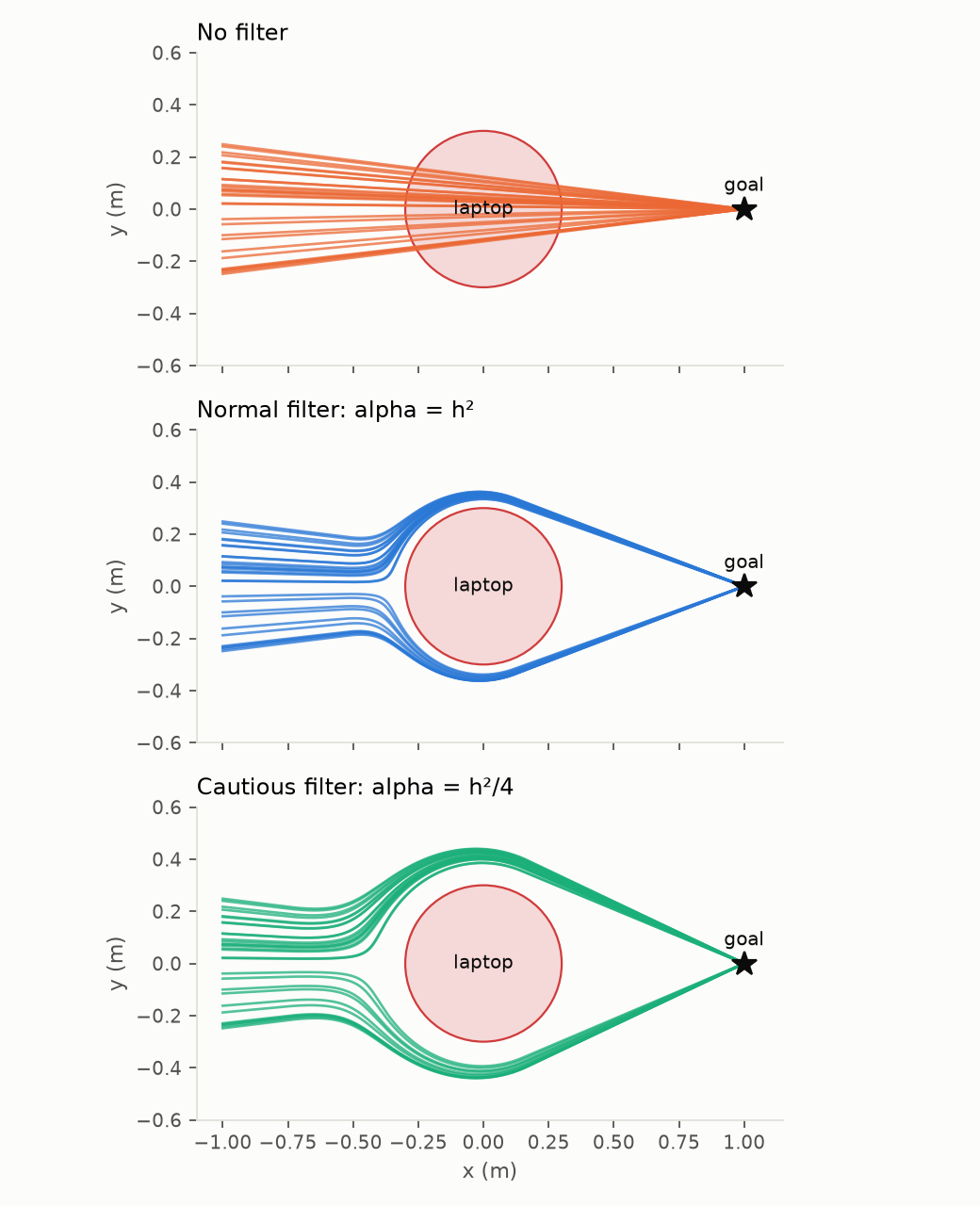
What it showed: entries fell from 100% to 0%, but trips took 37% longer, or 55% with caution. And a robot starting exactly in line with the object and the goal got stuck, 5 mm from the circle: the safety guarantee isn't a guarantee of progress. Also, the filter only protects what it's told about: a large book it didn't know about was entered in every run.
Experiment 2What changes with many objects and flat shapes?
Setup: the same point robot, now with a real QP solver and superquadrics. Concept: the trap diagram.
| Shape around a 0.30 × 0.44 m laptop | Area blocked | Goal straight behind | Goal to one side |
|---|---|---|---|
| Circle | 0.222 m² | 100% reached, 6.23 s | 100% reached, 5.12 s |
| Box-like, e = 0.3 | 0.157 m² | 0% reached | 100% reached, 5.18 s |
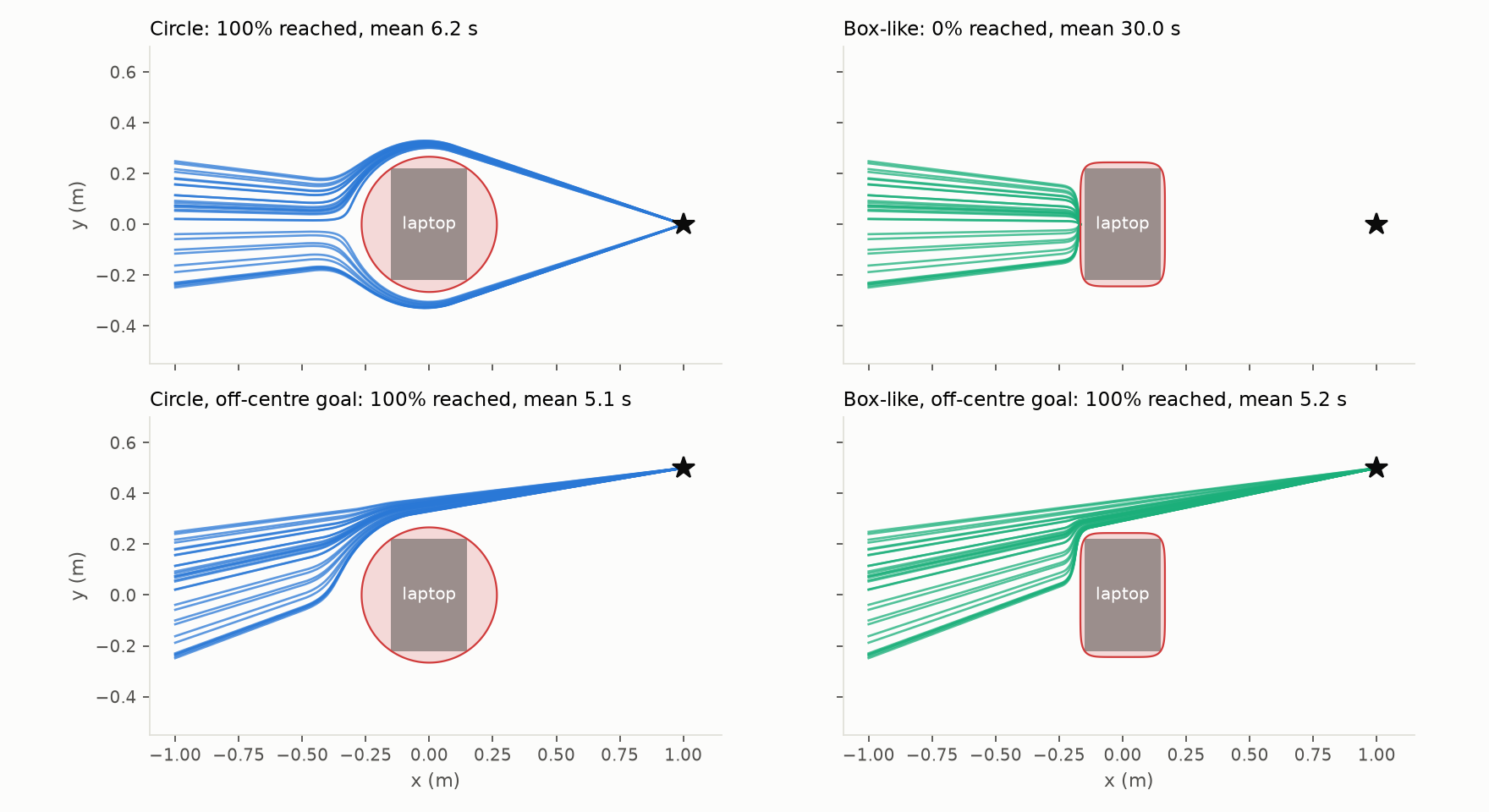
What it showed: telling the filter about a book cut entries in the book from 100% to 0%. But a tighter shape isn't simply better. The box-like shape blocked 29% less area, yet it failed one goal completely. The solver took 0.06 ms on average, against a 22 ms budget.
Experiment 3Can the same motion be safe with a sponge and unsafe with a cup?
Setup: a point in 3-D moving over a laptop, with rules depending on what it holds, from 200 starts per row. Concept: semantic regions.
| Rules | Goal straight behind | Goal to one side | Time, to the side |
|---|---|---|---|
| No filter | Passes over: 100%, reached: 100% | Passes over: 100%, reached: 100% | 3.18 s |
| Sponge, collisions only | Passes over: 100%, reached: 100% | Passes over: 100%, reached: 100% | 3.18 s |
| Cup, semantic | Passes over: 0%, reached: 0% | Passes over: 0%, reached: 100% | 4.09 s |
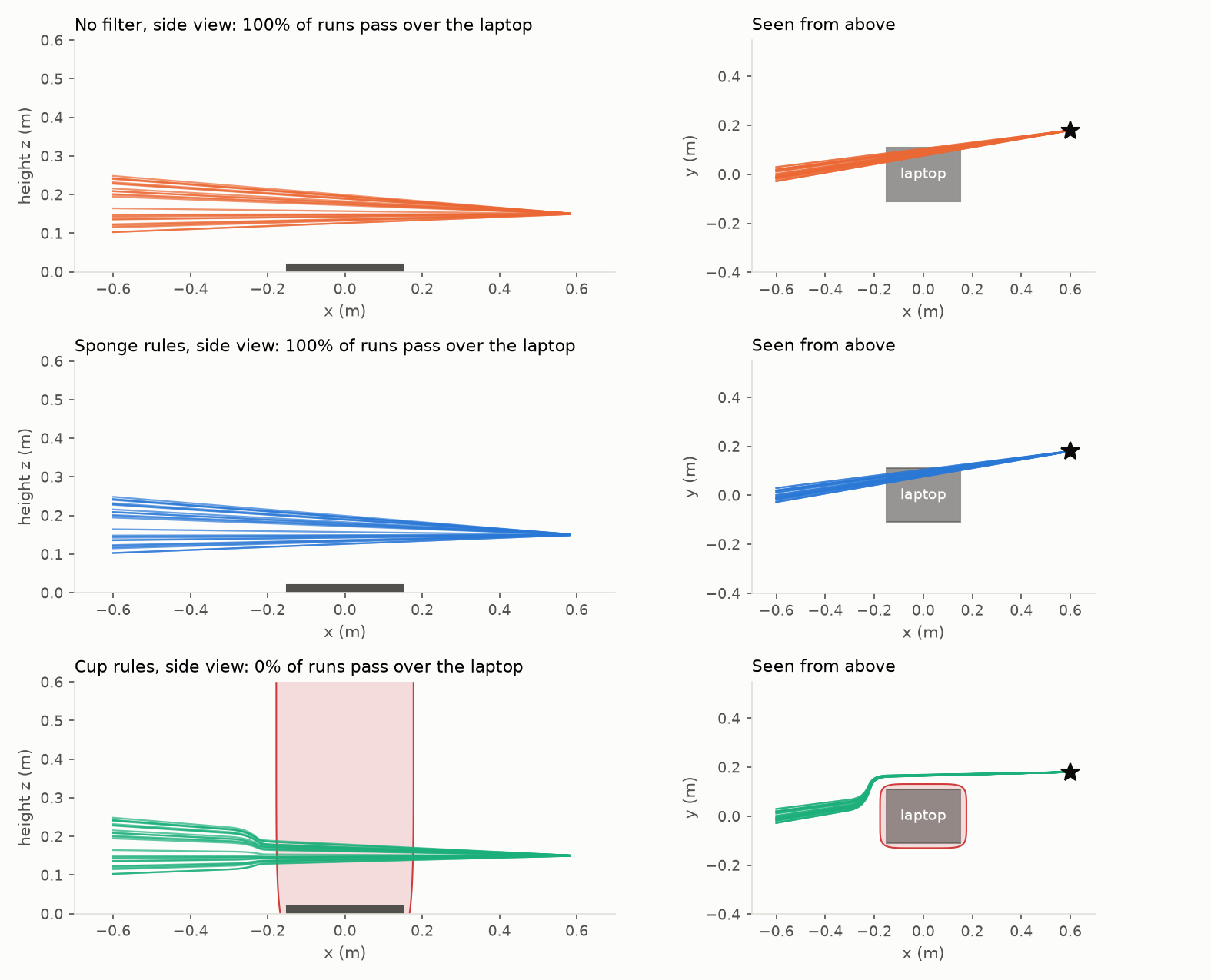
What it showed: this is the core result. A collision-only filter sees no problem with passing over the laptop, because nothing is there to hit. Only the rule list changes, not the maths. The trap appeared here too: at e = 1, every run got through, but the region blocked 2.17 times the true column, against 1.35 times at e = 0.3.
Experiment 4Does it still work on a 7-joint arm?
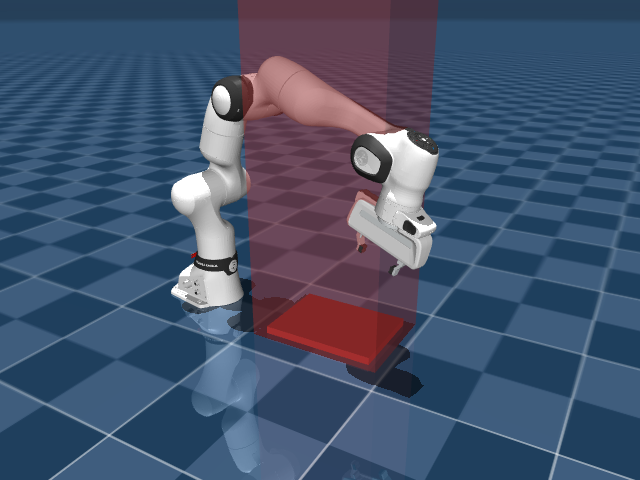
Setup: the Franka FR3 in MuJoCo, with rules on the tool point only, 30 runs per row, using MuJoCo's physics with position motors. Concept: inverse kinematics.
| Rules | Tool over laptop | Reached | Time |
|---|---|---|---|
| No filter | 100% | 100% | 2.75 s |
| Sponge | 100% | 100% | 2.75 s |
| Cup | 0% | 100% | 6.08 s |
How slow can the filter run?
| Filter rate | Entered region |
|---|---|
| 45 Hz | 0% |
| 15 Hz | 0% |
| 5 Hz | 0% |
| 2 Hz | 33% |
With 15 runs per rate, at about 0.3 m/s. Faster motion would need a higher rate.
What it showed: the method carries over to an arm, and the Jacobian checked out against numerical differences to 0.0000000002. The trap got worse near an edge: a goal 2.2 cm past the region's edge left the arm crawling, while one 16 cm past took 4.3 s.
Experiment 5Can it protect the whole arm and keep a cup upright?
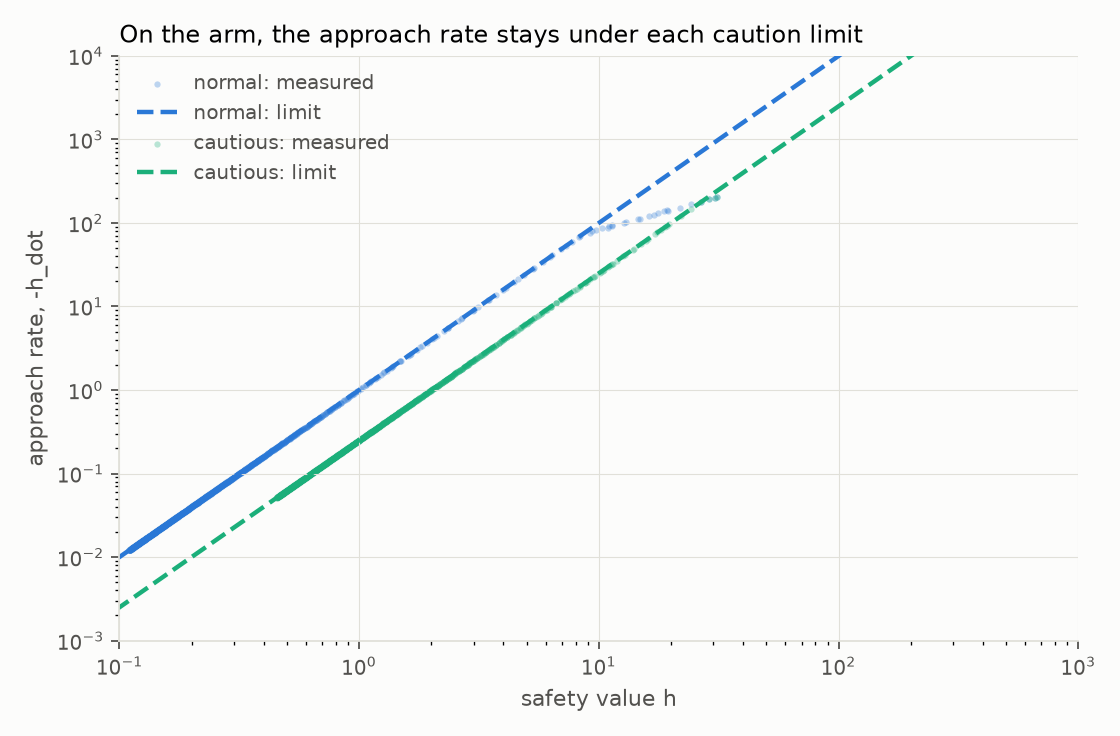
Setup: 20 spheres on the arm, sphere pairs for self-collision, and the rotation penalty. Clearance is measured independently, between MuJoCo's real meshes. 20 runs per row. Concept: the whole arm.
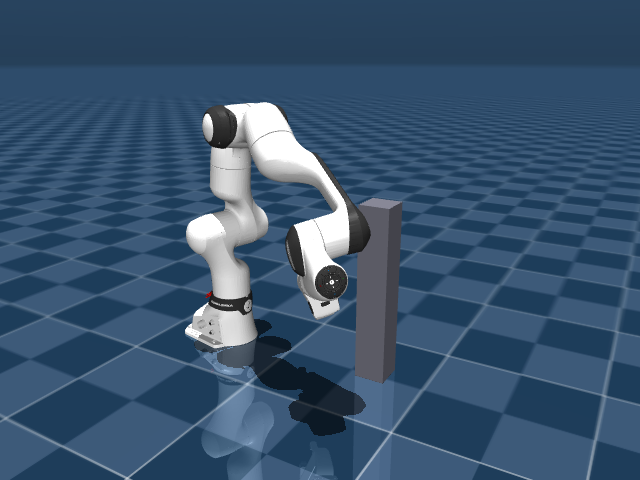
| Filter | Touched pillar | Lowest clearance | Reached |
|---|---|---|---|
| No filter | 100% | −8.7 cm | 100% |
| Tool point only | 100% | −8.7 cm | 100% |
| Whole arm | 0% | +6.5 cm | 0% |
Keeping the cup upright
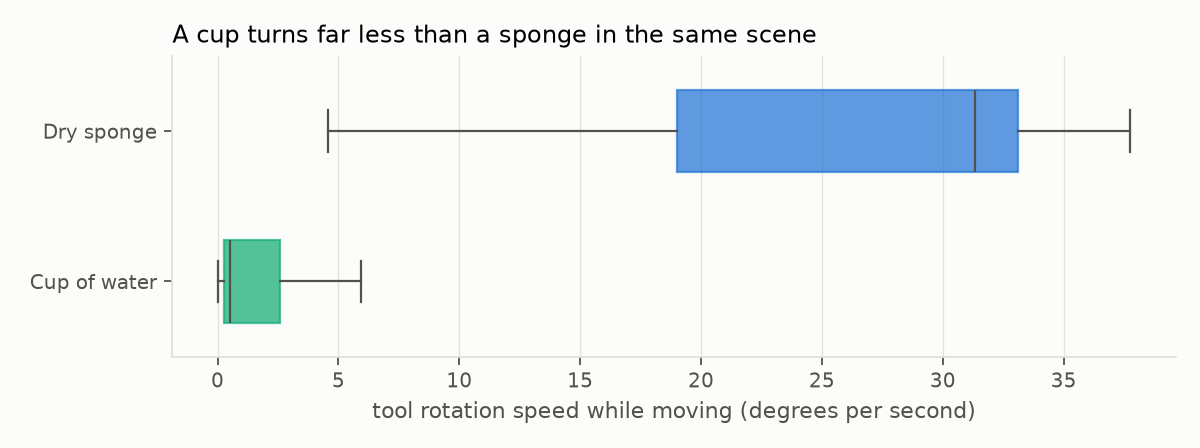
| Setup | Reached | Time | Median rotation speed | Largest tilt |
|---|---|---|---|---|
| Sponge, 3-D command | 100% | 2.14 s | 30.8 °/s | 26.9° |
| Cup, 3-D command | 100% | 4.37 s | 11.7 °/s | 28.2° |
| Cup, 6-D command | 100% | 4.55 s | 3.9 °/s | 6.6° |
| Cup, 6-D command and penalty | 100% | 5.21 s | 0.75 °/s | 2.8° |
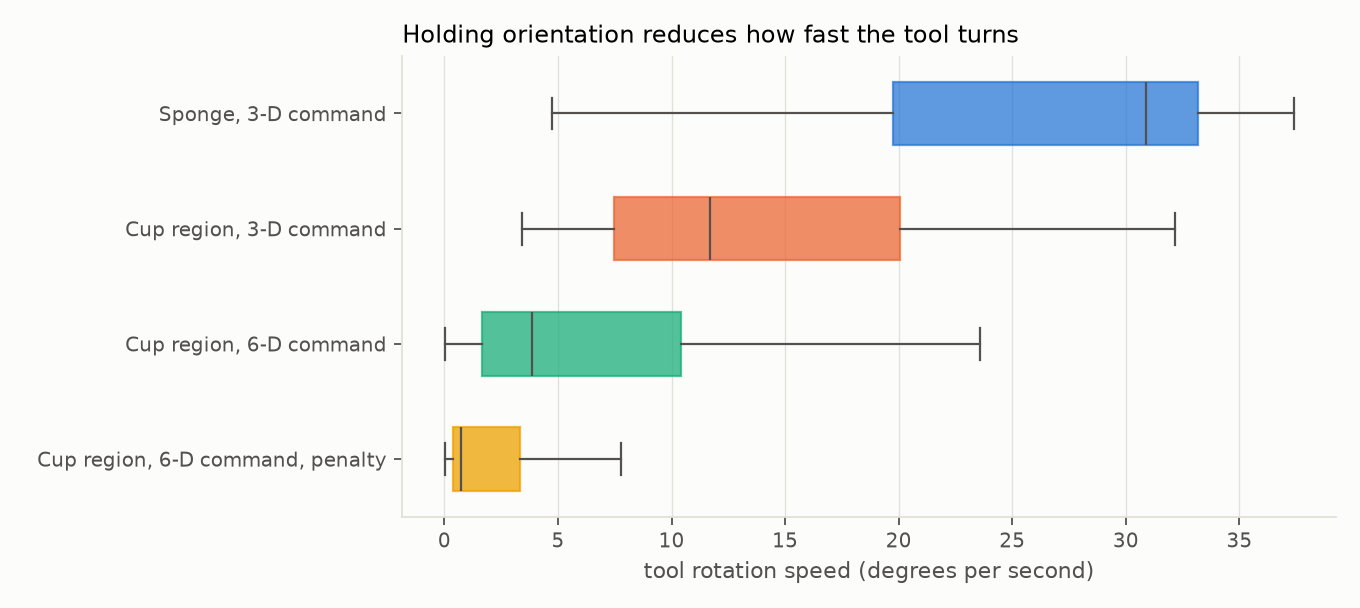
What it showed: a tool-only filter let the body go 8.7 cm into a pillar. The whole-arm filter stopped that, but it never reached the goal, and my oversized spheres probably make this worse. Most of the tilt improvement came from the 6-D command, which I had to add when the arm stalled. There's no real water here: tilt is measured on the hand, so this says nothing direct about spilling. The full filter took 3.3 ms per step on average with 321 rules.
Experiment 6Does the paper's main result appear in a kitchen?
Setup: the arm on a kitchen counter, with 8 cases following the layout of the paper's Table II. There are 5 scripted motions for each case, or 40 runs per filter. Every filter is scored against the semantic filter's full rule set.
| Scene | Held | No filter | Geometric | Semantic |
|---|---|---|---|---|
| Books | Dry sponge | 0.0 (100%) | 0.0 (100%) | 0.0 (100%) |
| Books | Cup of water | 47.5 (100%) | 40.7 (100%) | 0.0 (60%) |
| Laptop and books | Nothing | 0.0 (100%) | 0.0 (100%) | 0.0 (100%) |
| Laptop and books | Lit candle | 50.4 (100%) | 42.0 (100%) | 0.0 (60%) |
| Laptop and books | Cup of water | 50.4 (100%) | 42.0 (100%) | 0.0 (60%) |
| Balloons and towel | Cup of water | 28.1 (100%) | 0.0 (80%) | 0.0 (80%) |
| Balloons and towel | Lit candle | 61.9 (100%) | 21.8 (80%) | 0.0 (20%) |
| Balloons and towel | Knife | 9.6 (100%) | 0.0 (100%) | 0.0 (100%) |
Mean % of scored steps breaking any rule, with % of runs reaching the goal in brackets.
Reading these carefully:
- Why does it stop so often? Probably my setup, not necessarily the paper's method: my scripted controller can't steer around anything, and my spheres are oversized. I haven't separated these causes.
- Compare the pattern, not the values. My scenes and motions differ from the paper's.
- No real mesh touched an object in these runs. Object violations come from the cautious spheres, so those are stricter than real contact.
- A violation means breaking my typed rules. It doesn't show that something would really spill or burn.
- Two setup changes and one bug: I moved some objects and goals after checking only start positions and no-filter runs, and I fixed "above" regions that stopped too low. These results use the corrected regions.
What I learned
- Semantic safety does something collision checks can't. The same motion in the same scene is safe or unsafe depending on what's held, and only the rule list changes.
- Zero violations alone means little. A robot that never moves also scores zero, so safety has to be read with reach.
- A filter without a plan can get stuck. This was the most persistent problem, from the first experiment to the last. A tighter shape blocks less space but traps more often.
- Commands and penalties have to agree. The biggest surprise was an arm stalling because the command and the penalty fought each other.
- Speed wasn't the limit. About 2 ms per step on a laptop, though perception and a language model aren't included.
Not done yet
There's no language model producing the rules, no perception from a camera, no moving objects, no position error, and no real robot or person. I can't reproduce the paper's real kitchen, diffusion policies or user study here.