Results
What ran, and what we measured
Four robots and several ways of moving, in the MuJoCo and PyBullet simulators. None of these used new RL training: Pepper needs no RL for this task, and the Go2, G1 and Tencent MAX run policies that others have trained and published.
| Robot | Method | Main result |
|---|---|---|
| Pepper | MediaPipe + arm IK, no RL | Copied a person's arms from one video, with a 1.2° average forearm direction error against MediaPipe's estimate |
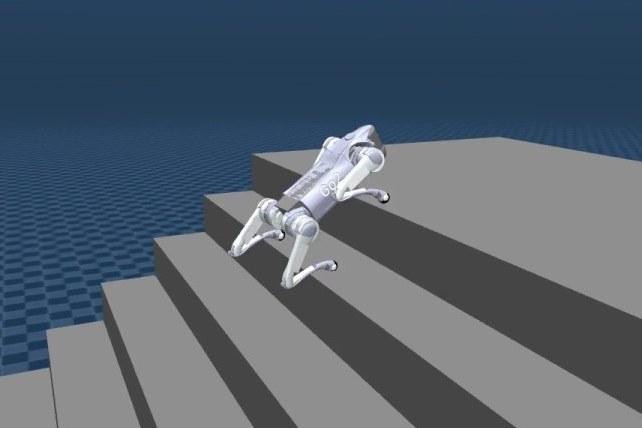
| Go2 quadruped | Trained RL policy | Reached 3.85 m/s when asked for 4, climbed 1.84 m of stairs, and stayed up through 200 N side pushes |
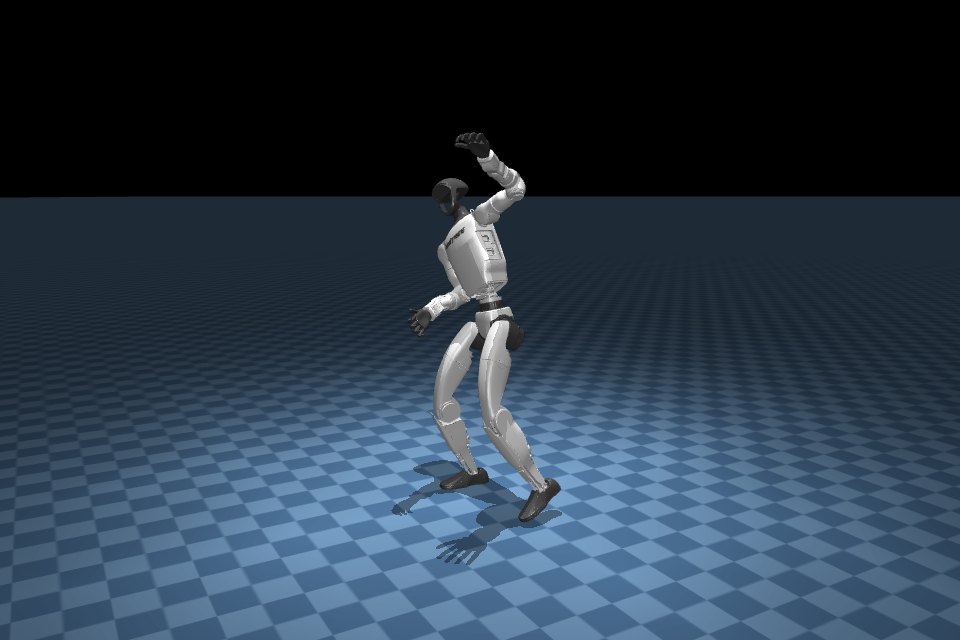
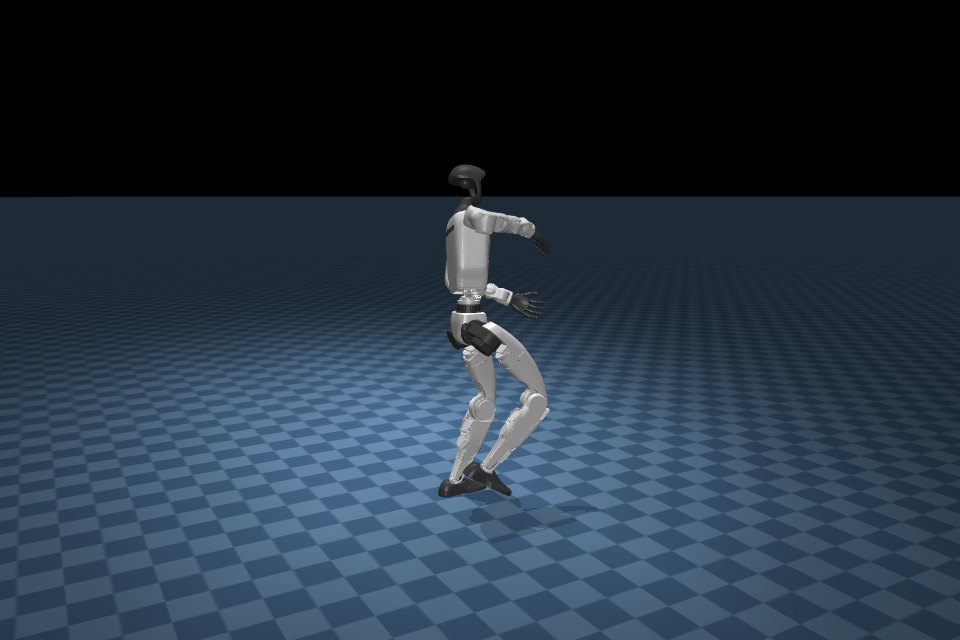
| G1, dances | One trained policy per dance | All 28 dances finished without a fall, with a median joint error of 0.082 rad |
| G1, GentleHumanoid | One force-limited policy, many motions | Followed new motions with no retraining, and its force limit changed how far a push moved the hand |
| Tencent MAX vs Go2 | Dog motion capture retargeted; pretrained MAX policies | On one forest course, the MAX jumped 25 cm logs and the Go2 used its lidar to go round them; both crossed wet ground without falling |
1
Pepper: MediaPipe + arm IK
A person's arm motion from an ordinary video, copied onto a simulated Pepper.
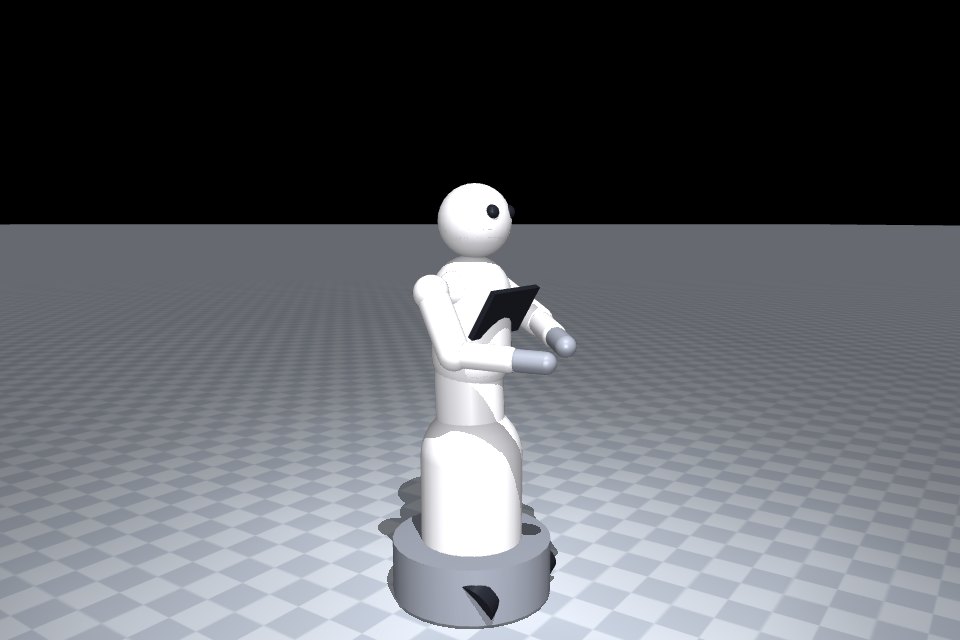
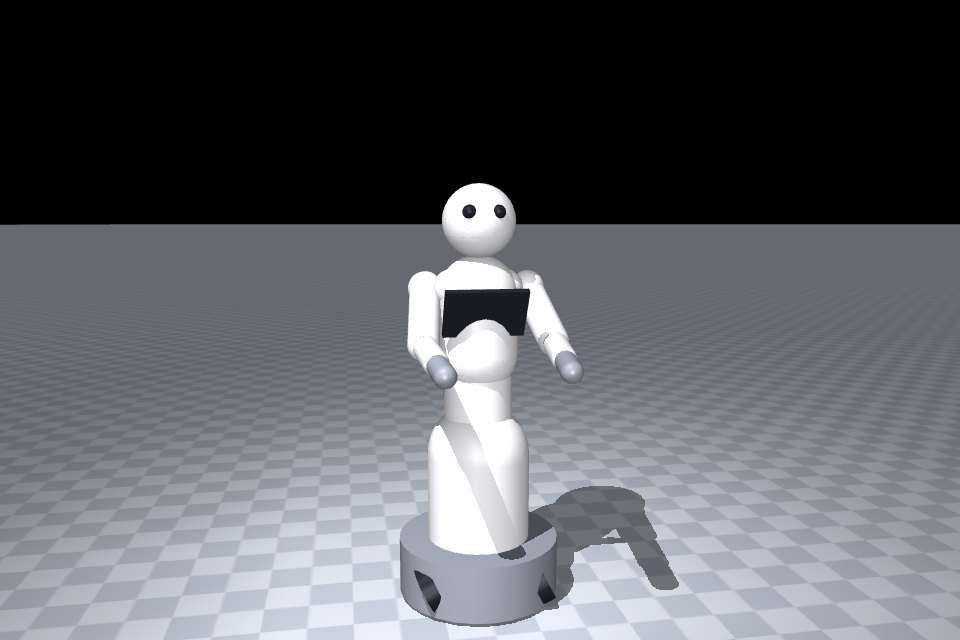
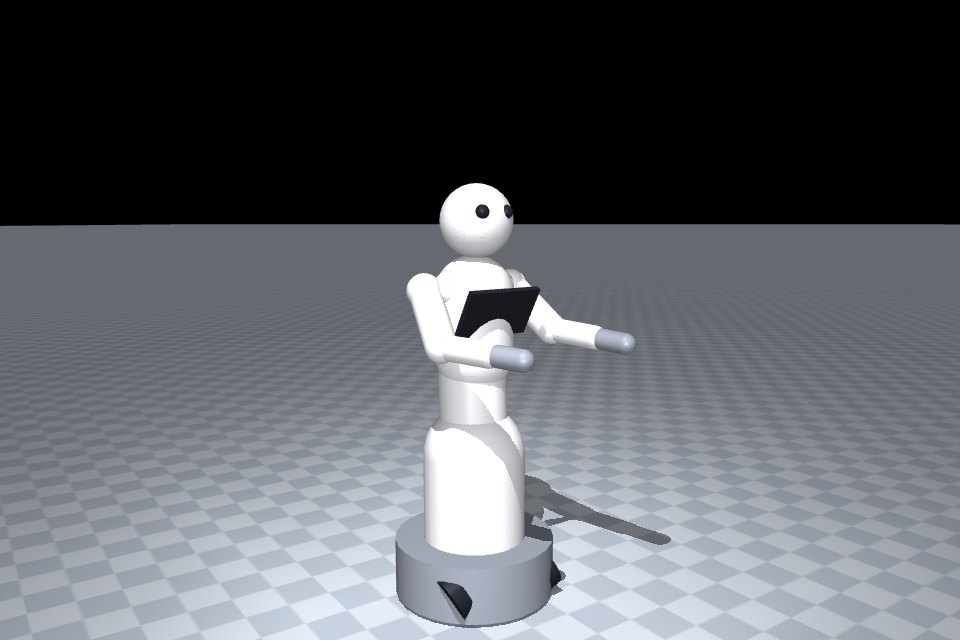
Robot only. The test video belongs to the GentleHumanoid authors, so the person isn't shown. The robot uses simple shapes built from Pepper's published joint data (Apache 2.0), not its real appearance.
How it works
MediaPipe finds the person's shoulders, elbows and wrists. The direction of each arm segment is measured relative to the person's chest, and damped inverse kinematics finds Pepper's four joint angles per arm that point the same way. The motion is then played in physics, with gravity and Pepper's published motor limits. The steps are explained on Mimic Human.
Measurements, on one 16-second video
| Measure | Result | What it means |
|---|---|---|
| Person found | 100% of frames | MediaPipe never lost them in this clip |
| Upper arm direction error | 3.9° average, 14° at the 95th percentile | Pepper against MediaPipe's estimate |
| Forearm direction error | 1.2° average, 4.3° at the 95th percentile | Pepper against MediaPipe's estimate |
| Tracking in physics | 0.034 rad | Simulated joints against their targets |
| Peak motor torque | 83% of the published limit | Within limits, with no joint saturated |
| Top joint speed | 2 rad/s | Capped on purpose, well below Pepper's limits |
| Centre of mass | At least 8 cm inside the wheels | A calculation; the base was fixed in place |
What we learned
- Pepper's shoulder is the main limit. Its upper arm can't swing inward, so the right shoulder sat near its limit in 72% of frames in this clip.
- Comparing views needs care. The match looked wrong until the camera was turned to the direction the person was facing. Pepper's arms had been right all along.
- A low error can hide a bug. A wrong motor order gave clearly bad tracking of 0.838 rad until it was fixed, while the IK error looked fine, so both have to be checked.
2
Go2 quadruped: a trained RL policy
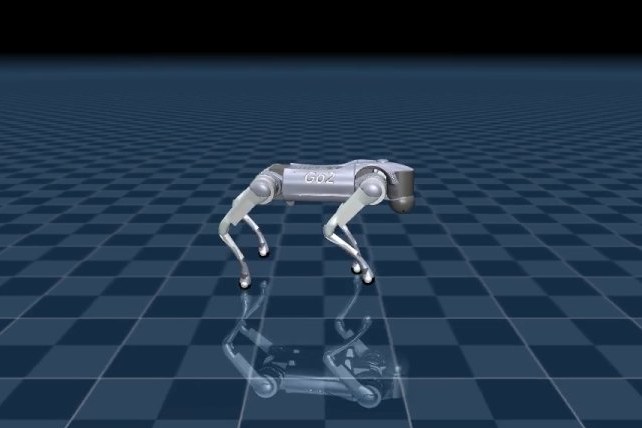
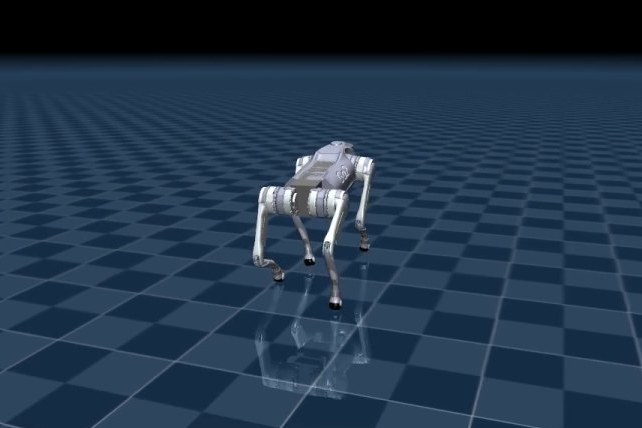
A published walking policy, tested with no retraining.
How it works
The policy is go2_rl_lab (Wu et al., RSS 2026, MIT licence), trained in simulation on mixed terrain. Fifty times a second it reads the last 10 frames of body turning rate, tilt, speed command, joint angles, joint speeds and previous actions: 450 numbers in all. It outputs 12 joint target angles. It has no camera, so it senses stairs only through its legs.
Measurements, against an earlier flat-ground policy
| Test | go2_rl_lab | Earlier flat-ground policy |
|---|---|---|
| Asked for 1 m/s | 0.91 m/s | 0.98 m/s |
| Asked for 2 m/s | 1.91 m/s | 1.85 m/s |
| Asked for 4 m/s | 3.85 m/s | 2.58 m/s |
| Backward, asked for 2 m/s | 1.95 m/s | 1.37 m/s |
| Turning at 3 rad/s | 2.99 rad/s | Fell at 1.7 s |
| Side pushes, 0.2 s, two tries each | No falls up to 200 N; 1 of 2 at 300 N | 1 of 2 at 150 N; 2 of 2 at 300 N |
| Stairs and slopes | Climbed all three test courses | Fell on two, stuck on the third |
This comparison favours go2_rl_lab: the earlier policy was trained only on flat ground and on a different robot model, and both ran here on the go2_rl_lab authors' model and scenes. At low speed, the earlier policy tracks speed slightly better.
A real gait change
No one programmed a change of gait. As the speed rises, a flight phase simply appears:
| Actual speed | 0.91 m/s | 1.91 m/s | 2.95 m/s | 3.85 m/s |
|---|---|---|---|---|
| All four feet off the ground | 0% | 20% | 36% | 41% |
What we learned
- Moving to another robot model has a cost. On a different Go2 model, top speed fell from 3.85 to 3.64 m/s. That's small, but a reminder that a policy is tied to its training.
- Top speed works the motors hard. At 4 m/s, the motors reached their limit in 17% of steps, so a real robot would need much more care.
- It has no sense of direction. With nothing steering it, it drifted off narrow stairs and walked into a wall on the race course, so that course doesn't count as a result.
3
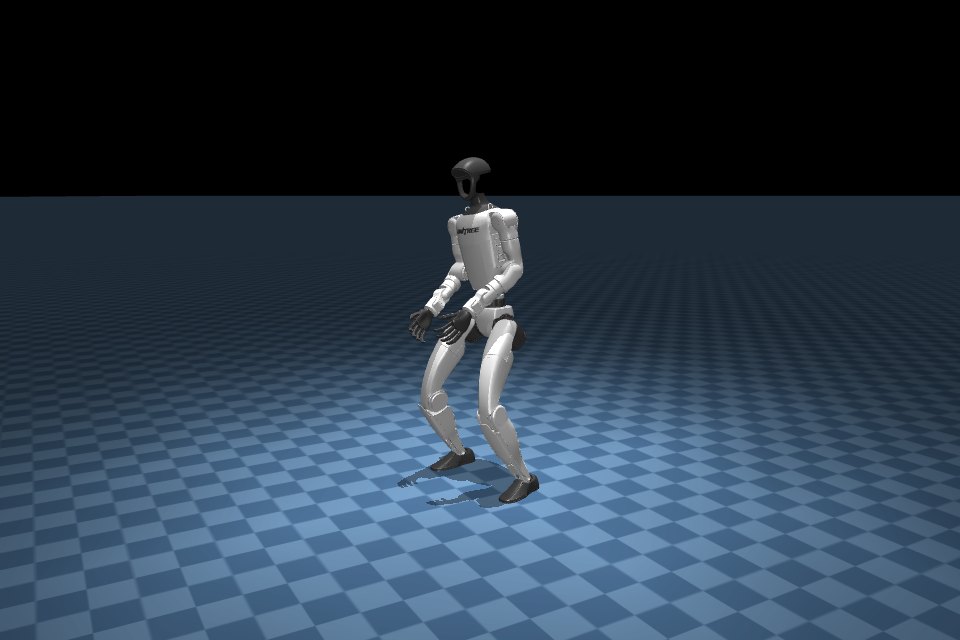
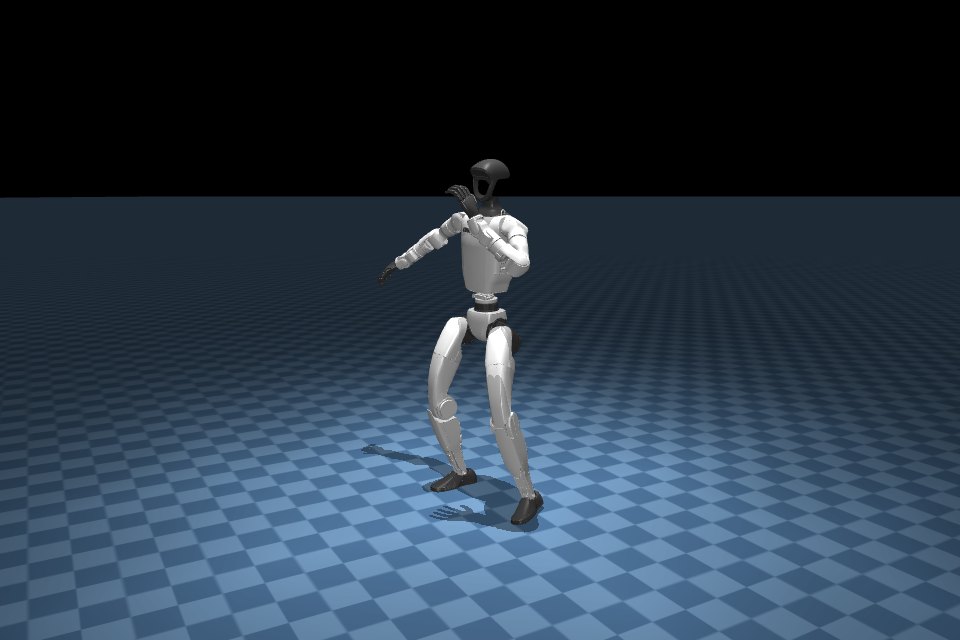
Humanoid G1: dance policies
One trained policy per dance: very accurate, but it can do only that dance.
How it works
The G1 Moves dataset (CC BY 4.0) publishes a BeyondMimic-style policy for each motion. Each policy is rewarded for matching a single recorded dance while staying balanced, so it can specialise completely. Each one reads the target pose for the current moment, and the robot's state, then outputs 29 joint targets at 50 Hz.
Measurements
| Measure | Result, over 28 dances and 19.8 minutes of motion |
|---|---|
| Finished without a fall | 28 of 28 |
| Joint error | Median 0.082 rad; range 0.066 to 0.152 rad |
| Body position error | Median 4.8 cm; worst dance 13.9 cm on average |
| Peak motor torque | Median 81% of limit, and some dances reach the limit |
4
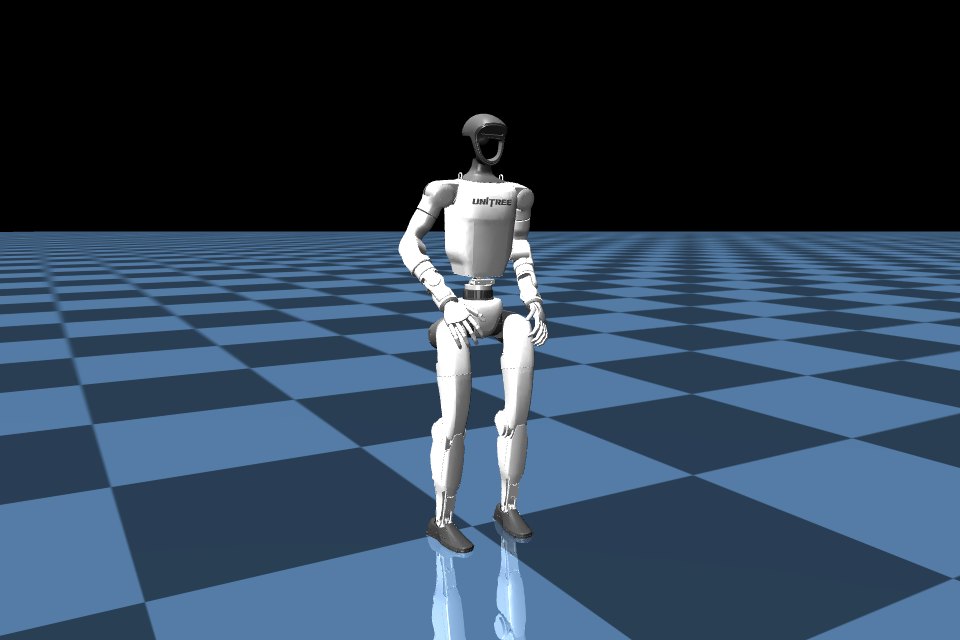
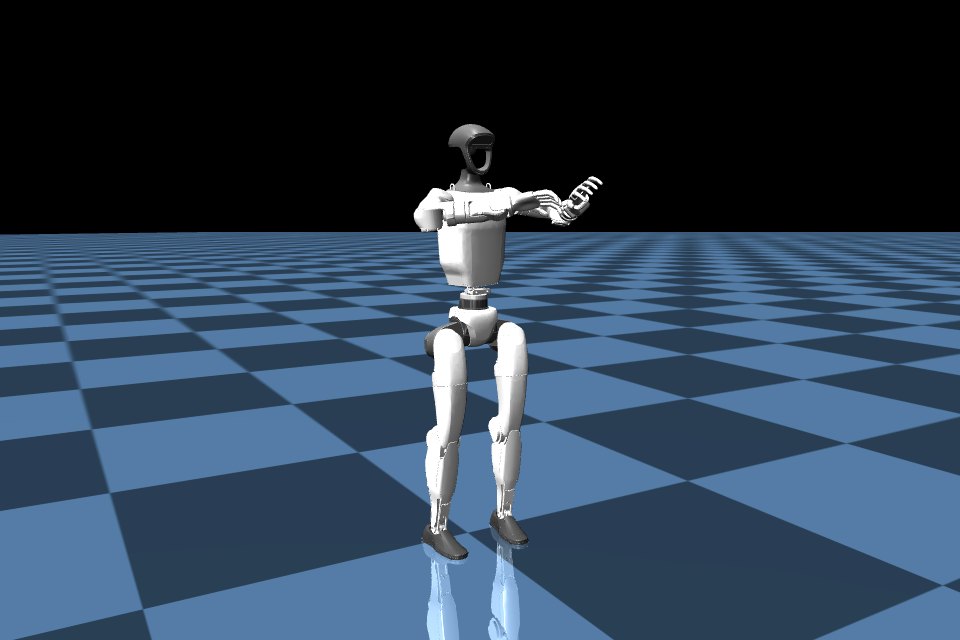
Humanoid G1: GentleHumanoid
One policy for many motions, which gives way when something pushes on it.
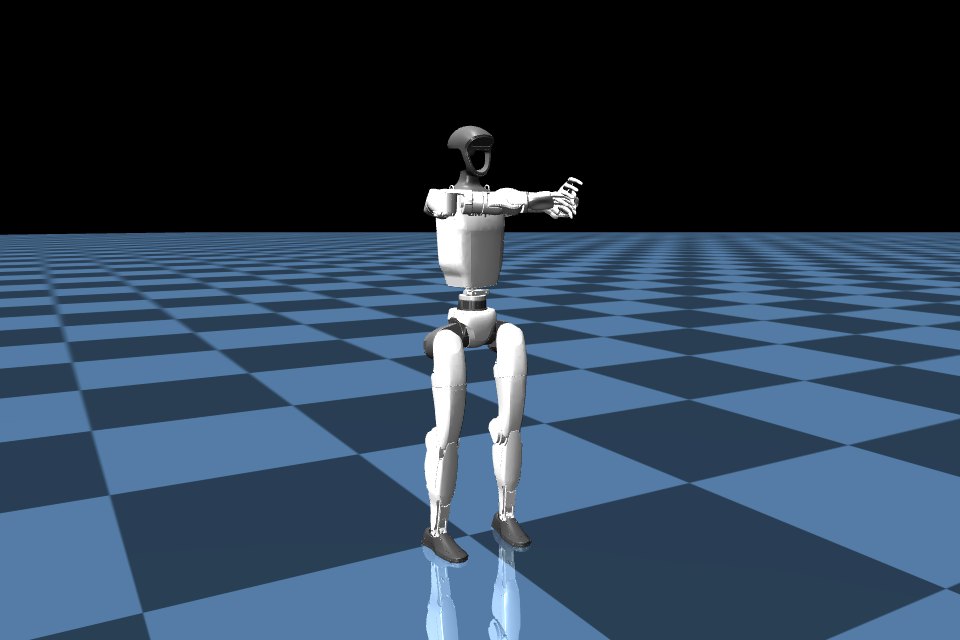
How it works
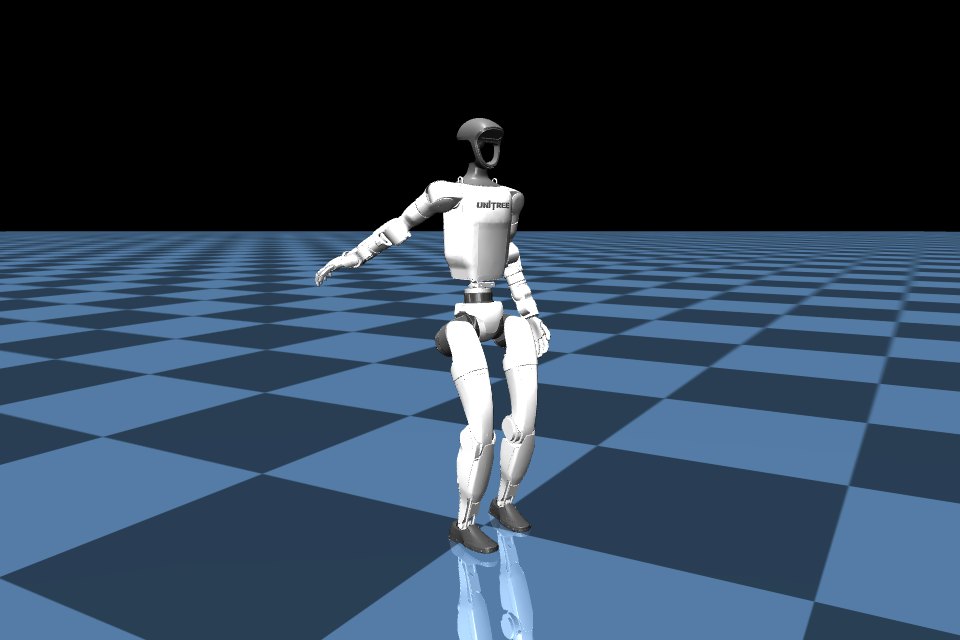
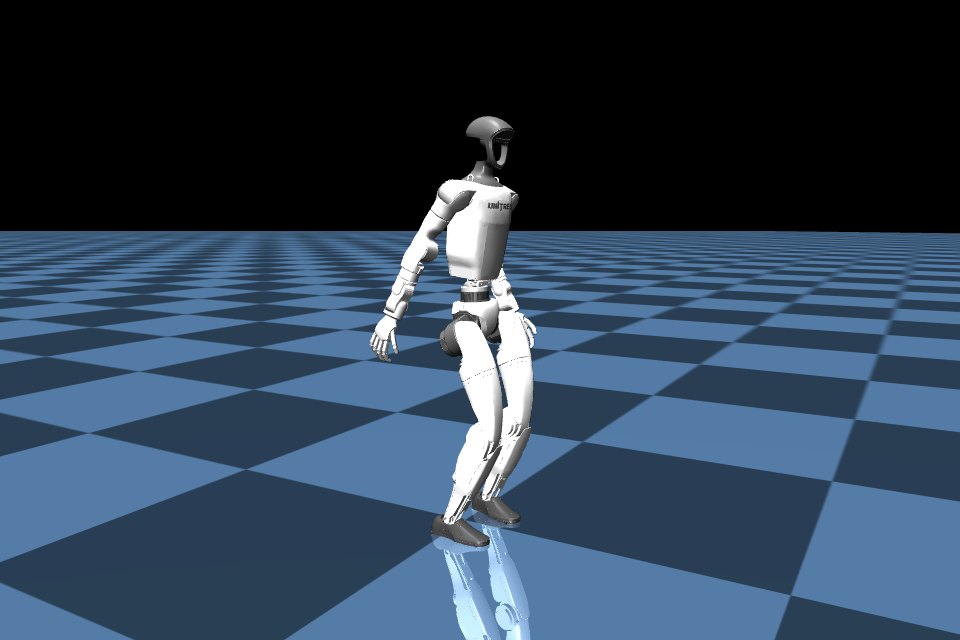
GentleHumanoid (Lu, Feng et al., Stanford) is trained on many human motions, while simulated forces push and pull on its arms. It tracks a spring-damper reference with a cap on the driving force, and you can set that limit from 5 to 15 N while it runs. It doesn't need a force sensor at run time: it learned how to respond in training.
The force limit changes behaviour
| Force limit | Hand moved by a 20 N push | Hug arm error, in free air | Falls |
|---|---|---|---|
| 5 N | 36.6 cm | 0.162 rad | None |
| 10 N | 22.6 cm | 0.134 rad | None |
| 15 N | 15.5 cm | 0.122 rad | None |
Softer costs accuracy. As the limit falls, the hand gives way further, but the arm also follows the hug less closely, even with nothing touching it.
General policy or dedicated policy?
We ran both on the same reference motion, in free air, for each dance:
| Arm joint error | GentleHumanoid | Dedicated dance policy |
|---|---|---|
| Median of 27 dances | 0.199 rad | 0.081 rad |
| Needs training for a new motion | No | Yes |
| Force limit | Yes, 5–15 N | None set |
| Falls in 28 dances | 1, at 52.6 s of a long dance | 0 |
The trade-off: the dedicated policy is about 2.5 times more accurate on arms. GentleHumanoid can follow new motions and give way to contact. Which is better depends on the task: a stage dance favours the first, and contact with people favours the second.
The gap grew with motion speed. It wasn't always in the dedicated policy's favour: on one slow dance, GentleHumanoid was the more accurate. The hug has no dedicated policy yet, so its gap can't be measured directly.
5
Lifelike dog: Tencent MAX and Unitree Go2
Working with the data and policies from Tencent Robotics X’s “Lifelike Agility and Play”.
How it works
Lifelike Agility and Play (Han et al., Nature Machine Intelligence 2024) publishes dog motion capture and pretrained policies for Tencent’s MAX robot. We used both:
- Retargeting. The dog clips were scaled to the Go2’s size, then each foot was matched by inverse kinematics in MuJoCo. In about 10% of the source frames the dog’s feet sit up to 9 cm below the floor, so those frames are lifted before matching.
- The MAX. Its pretrained hurdle policy runs in PyBullet, as published. The Go2 uses go2_rl_lab (the policy in section 2) in MuJoCo, steered by a simple path follower.
- One course for both. A 20 m forest course with the same logs, gaps and wet strips in each simulator, both asked for 2 m/s.
Measurements
| Course | Tencent MAX | Unitree Go2 |
|---|---|---|
| Five logs, 8–14 cm | 8.5 s, no fall | 11.5 s, no fall (no sensors used) |
| All logs one height | Passed 15, 20 and 25 cm; 30 cm only after struggling | Passed 15 cm; fell at 20 and 25 cm |
| Four 25 cm logs with gaps | Jumped all four, 9.1 s | Found each gap with its own lidar and A*, 13.4 s |
| Gap course with mud, slick and ice strips | No falls in 3 runs; one run stuck about 3 s at the last log | No fall, 63 foot slips, 14.7 s |
The two robots ran in different simulators (PyBullet and MuJoCo), so times aren’t a strict comparison. The MAX’s results varied from run to run.
6
Limits of these results
What these numbers can't tell you.
- Simulation only. Nothing ran on a real robot. Real motors, sensors and floors are harder.
- Few runs. Most tests ran once with no added randomness, so they show what a policy can do, not how reliably.
- No force was measured on a person. The hug ran in free air, and pushes were applied in simulation. These results don't show that any of this is safe for contact with people.
- Different robot models. Each policy ran in its own model when compared, so differences under about 0.01 rad shouldn't be read closely.
- One video for Pepper. It was a single person and clip, and its error is against MediaPipe's estimate, not the true arm pose.
- Software from other authors. The Go2, dance, GentleHumanoid and MAX policies were trained by their authors, and these tests only ran them.